Pull up recent closed sales in zip code 37220 and the numbers look like two different markets got filed under the same mailing address. Over the 12 months ending in April 2026, the zip recorded 112 closed sales ranging from $320,000 to $8,450,000, with a median of $968,750. That spread is not a typo and it is not noise. Homes in Crieve Hall, a neighborhood inside that same zip, typically close between $500,000 and $900,000. A few blocks away, homes in Oak Hill and the adjoining slice of Forest Hills close between $1.5 million and $8 million or more.
Most explanations for that gap reach for schools, curb appeal, or "location, location, location." The real answer is more specific and more useful to anyone actually shopping this corner of Nashville: the price band changes exactly where the city limit does. Oak Hill is not a neighborhood name a listing agent invented. It is a separately incorporated city with its own zoning code, and that legal status is the mechanism setting the price floor, not a side effect of it.
A Charter Written Ahead of a Merger
Oak Hill incorporated in 1952 under Tennessee's General Law Manager-Commission Act, a charter type still on file with the University of Tennessee's Municipal Technical Advisory Service. That date matters because Nashville and Davidson County voted to consolidate into Metro government on June 28, 1962, with the new Metropolitan Government implemented on April 1, 1963, under an arrangement that let existing incorporated communities keep their own zoning and police powers. Any community that had already incorporated by that point kept its own zoning authority. Any unincorporated area got folded into the single Metro code that governs most of the county today.
Oak Hill is one of six small cities inside Davidson County that still operate this way, alongside Belle Meade, Berry Hill, Forest Hills, Goodlettsville, and Ridgetop. Land inside those six boundaries was never absorbed into Metro's zoning map. The City of Oak Hill's own government page puts it plainly: the city is completely residential with no commercial establishments, and its primary function is community planning, land use, and zoning. That single sentence is doing more work than it looks like. It means a city commission, not a citywide Metro council with competing constituencies, has spent more than seventy years deciding what gets built inside these eight square miles.
What the Zoning Actually Locks In
Oak Hill's code sets six residential zones, and across them minimum lot sizes run from 10,000 square feet up to 4 acres depending on the zone, according to the city's zoning ordinance. Only single-family dwellings are permitted as a matter of right. Multifamily housing is not allowed anywhere in the city. Churches and schools require conditional use permits. One house per lot, full stop.
To put that in context, Metro Nashville's residential zoning ladder tops out at R80, a low-density district requiring an 80,000-square-foot lot, a little under 2 acres, and permitting single and two-family homes. Oak Hill's most restrictive zone requires double that lot size and allows only one single-family home per parcel. Metro could theoretically rezone a Nashville neighborhood tomorrow if the political will existed. Oak Hill's zoning does not sit inside that process.
| Metro Nashville's largest standard residential district | Oak Hill's largest residential zone | |
|---|---|---|
| Minimum lot size | 80,000 sq ft (R80) | Up to 4 acres |
| Governing body | Metro Council, countywide | Oak Hill Board of Commissioners |
| Multifamily allowed | R80 permits two-family homes | Not permitted anywhere in the city |
The city has a variance process. A builder who wants to subdivide a lot or add a second structure is negotiating with neighbors who have spent decades defending the same rules, not filing paperwork into a bureaucracy.
The Zip Code Splits the Same Way the Zoning Splits
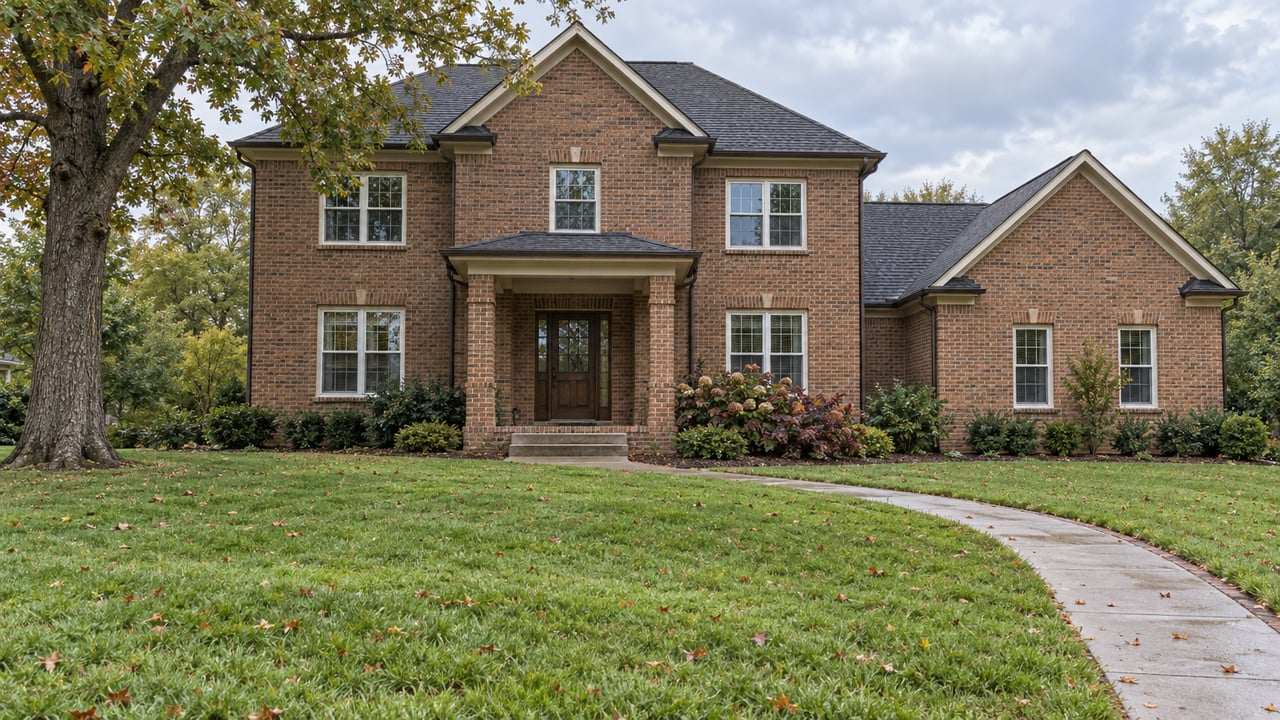
That structure explains the bimodal pricing inside 37220, as of April 2026, far better than any lifestyle narrative does. Crieve Hall sits inside Metro's zoning jurisdiction, where smaller lots and higher density are permitted by right. Oak Hill and the neighboring portion of Forest Hills sit inside a jurisdiction that has never allowed that density to exist. Buyers are not just paying for square footage or a school assignment when they cross that line. They are paying for a supply of buildable, subdividable land that has been fixed by ordinance since before most of the current housing stock was built. Most Oak Hill homes date to between 1950 and 1980, the era right after incorporation, when postwar ranches and brick colonials went up on the 1 to 2-plus acre lots the zoning made standard.
What Is Actually Happening to Prices Right Now
Zoom into the transaction data and the current picture gets more interesting than a simple story of runaway demand. Over the three months ending in May 2026, Oak Hill's median sale price reached roughly $2.4 million, up 8.8 percent from the same period a year earlier. But homes are also taking longer to sell, averaging 95 days on market compared to 73 days the year before. Rising prices paired with slowing sales is not what a simple demand spike looks like. It reads more like a market where sellers are holding firm on price in a supply that cannot expand, while the pool of buyers willing and able to close at that number has gotten thinner and more selective. Only 29 homes sold in Oak Hill in May 2026, up from 20 the year before, small enough numbers that a handful of high-end closings can swing a median significantly in either direction.
That thin sample also explains why published "median price" figures for Oak Hill vary so widely depending on the source. Some portal figures published in late 2025 put the median list price for active Oak Hill listings above $5 million, more than double the closed-sale median from spring 2026. That gap is not a contradiction so much as a methodology difference: a median of what is currently listed for sale skews toward whatever large estate happens to be on the market that month, while a median of what actually closed reflects real buyer behavior over a rolling window. Anyone comparing Oak Hill numbers across two websites should always check whether they are looking at asking prices or closed sales, and over what time period, before treating the number as comparable.
Before You Renovate, Check Who's in Charge
Buyers planning to build, add on, or subdivide inside Oak Hill are dealing with a live, active local government, not a dormant HOA. The Board of Commissioners has spent recent meetings on exactly this kind of granular authority. At its March 24, 2026 meeting, the board approved a settlement, at no cost to the city, in litigation between the city and Churchill Properties. The following month, commissioners took up a revised fence ordinance, an issue that had generated enough public comment over the prior year that the language was still being refined to address height, materials, and front-yard placement. These are not abstract governance exercises. They are the actual mechanism deciding what a homeowner two doors down is allowed to build.
Practically, that means anyone buying in Oak Hill with plans to expand a home, add a pool, or remove mature trees should confirm what the zone allows before writing an offer contingent on those plans. The City of Oak Hill lists the Board of Commissioners as a five-member body. It answers directly to residents, which tends to make the process slower and more particular than in areas governed by Metro's larger planning apparatus.
FAQ
Is Oak Hill technically part of the city of Nashville? Oak Hill sits inside Davidson County and inside the broader Nashville metropolitan area, but it is a separately incorporated municipality with its own elected Board of Commissioners, mayor, and zoning authority. Metro Nashville handles fire and police service for Oak Hill, but land use decisions are made by the city itself.
Can a buyer add a duplex or accessory dwelling unit in Oak Hill? No. Oak Hill's zoning code permits only one single-family dwelling per lot across all six residential zones, and multifamily housing is not a permitted use anywhere in the city.
Why isn't there a coffee shop, grocery store, or gas station inside Oak Hill? The city is completely residential, with no commercial establishments. Residents rely on nearby Green Hills, roughly ten minutes away, and Brentwood for retail and dining. That is a deliberate outcome of the same zoning structure that keeps lot sizes large, not an oversight.
If you are weighing Oak Hill against a neighboring zip code, the number that matters most is not the median on a listing site. It is which zoning jurisdiction the parcel actually sits in. First Class Realty, LLC works these boundary lines across Middle Tennessee every week and can walk you through what a specific address allows before you write an offer. Search All Homes to see what's currently available on either side of that line.
This article is general information, not legal, tax or financial advice. Consult a qualified professional about your situation.